If your home in Columbus and Muscogee County is not livable after Isaias, you may be able to stay on your own property while it is repaired. We deliver a furnished travel trailer to your driveway or yard, set it up, have it connected, and service it for the whole stay. When a carrier approves the trailer, we can bill the carrier directly.
Local rules. Columbus's code lets the city permit a temporary trailer or RV in any zoning district while a home is repaired after a declared emergency, with engineered plans approved by the health department and Inspections and Code, for up to six months plus up to six more. Each rule is linked to its official source below.
Housing a crew? No Columbus code we found lets a crew live in RVs on a job site; RVs belong in licensed RV parks, and contractors working in a declared disaster area must register with Inspections and Code. Crew rules and housing
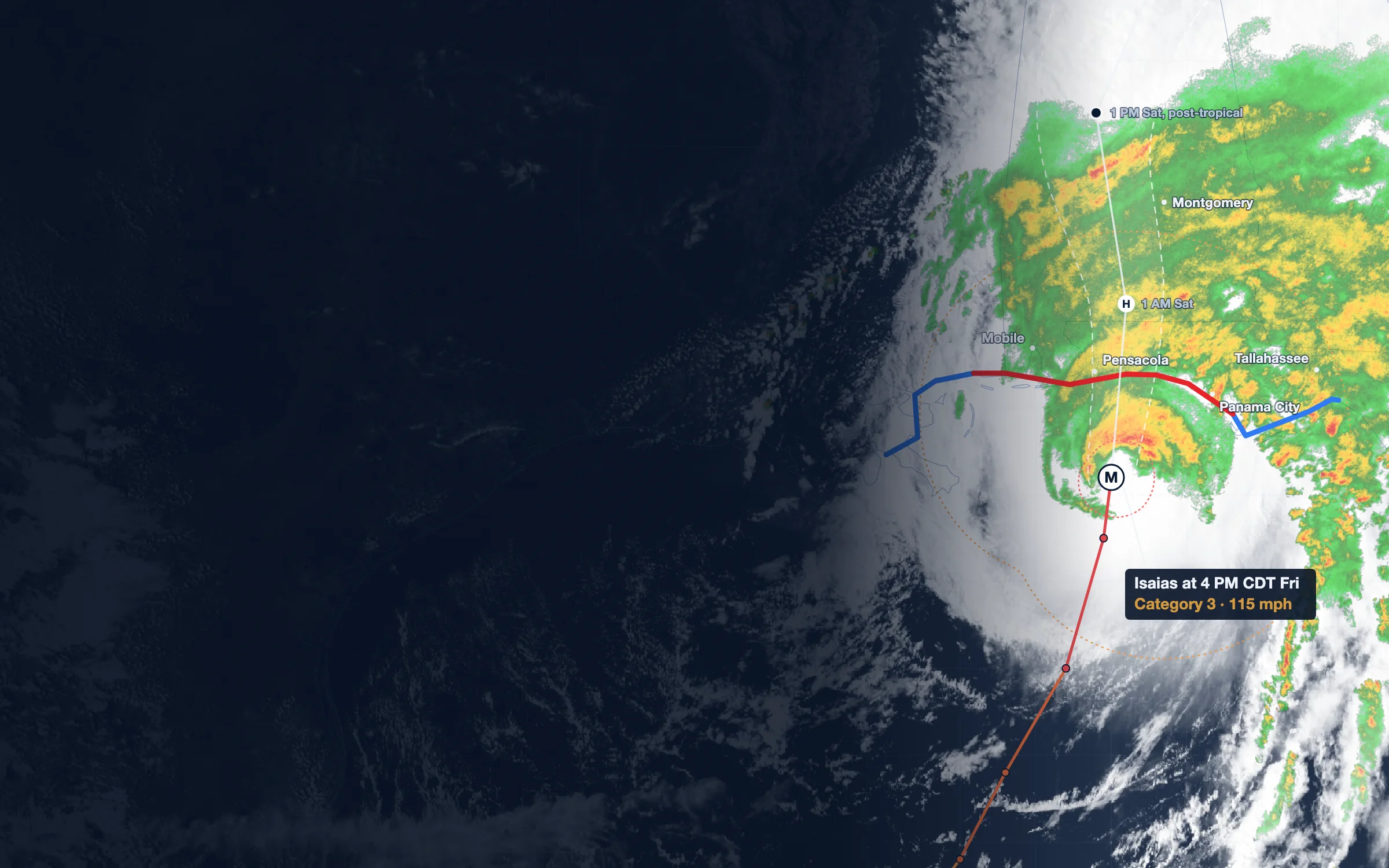
Satellite: GOES-East. Radar: NEXRAD. Track, cone, and warnings: National Hurricane Center Advisory 13. All at 4 PM CDT Oct. 9. Latest forecast: nhc.noaa.gov
Go back into an evacuated area, and plan a delivery there, only when local officials say it is safe, and follow road closures. For Muscogee County, official updates come from the Columbus Office of Homeland Security and Emergency Management and Georgia Emergency Management and Homeland Security Agency.
Checked against the sources above as of . For current conditions, go to the source.
Whether a trailer can stay on your lot is decided by your city, or by the county outside city limits, and by your HOA if you have one. Here is what each one’s own code or official page says, in short. Our parent brand covers the residential RV rules for Columbus and Muscogee County in detail.
Governor Kemp's executive order of October 8, 2026 declared a statewide state of emergency for Hurricane Isaias, covering all of Georgia; it has no county list. The order does not set a rule for trailers on residential lots; the city or county decides. As of October 9, 2026, we found no Columbus local declaration for Isaias on the city's news page. Outside the emergency section, the zoning code addresses RVs on residential lots only as storage. If the lot is in a flood hazard area, the flood rules say an RV must be on site fewer than 180 consecutive days or be fully licensed and ready for highway use, or meet the elevation and anchoring rules for new construction.
That depends on your policy and your adjuster. When a carrier approves the trailer, we can bill the carrier directly, so you are not fronting the cost. Our parent brand explains the claim side on 1st Choice Living’s Georgia page. Once the placement is arranged, the trailer, delivery, and service are ours.
Every size arrives furnished, with real beds, a full kitchen, a bathroom with a shower, and heat and air conditioning. More on a trailer on your property while you rebuild.
We work with any temporary housing company. If one is handling your housing, ask them to place you with Temporary RV Living, or with our parent brand, 1st Choice Living, for a trailer on your own lot in Muscogee County. They send us the placement, and we deliver, set up, and service the trailer.
For restoration, roofing, tree, utility, and response crews working in Columbus and Muscogee County. Bring the housing to the work. We deliver travel trailers to the site, or as close as the ground allows, and set up and connect them the same way we do in a driveway. A two-person crew fits one trailer. A full crew takes a cluster, and the Workforce Bunkhouse sleeps six or more per trailer, with a kitchen and a bathroom the crew shares. One point of contact runs the placement, it lands on one invoice billed directly to the company, and we handle the LOA, COI, and compliance paperwork your office or your client requires.
Columbus's emergency code also requires contractors working in a declared disaster area to register with Inspections and Code and post a building permit. For crew trailers, a licensed RV park is the safe place under the code; ask Inspections and Code at 706-225-4126 before placing an RV anywhere else. More on crew housing.
Water, sewer or septic, and electrical connections are completed by licensed, insured contractors from our preferred vendor network, so you do not hire an electrician or a plumber. We look at how far the trailer will sit from the water, sewer, and power it will use, and confirm the site with you on the call before the trailer rolls.
Electric service in Muscogee County comes from the utilities below. Each posts its own outage and storm updates.
Septic: Columbus's temporary dwelling permit needs plans approved by the Columbus/Muscogee County Health Department. Georgia's on-site sewage rules cover systems serving recreational vehicles and require a county health department permit before any part of a septic system is installed. If the trailer will tie into a septic system, ask the county health department first. Source: Georgia Department of Public Health, on-site sewage rules, Chapter 511-3-1
Call the office for the city where the trailer will sit, or the county office outside city limits. Ask whether a travel trailer may be used there, for how long, and which permits the hookups need.
Answer a few questions in the request form and a rep calls you back with a written quote, or call (214) 493-1515.
Our sister brand LossMap covers documenting a property from the air before tarps go on and debris comes off, on LossMap’s Columbus and Muscogee County page.
Columbus's emergency code lets the Council or its designees permit a temporary trailer or RV in any zoning district while the home is repaired, after a declared emergency, with engineered plans approved by the health department and Inspections and Code. The permit runs up to six months, with up to six more for continuing hardship. Ask Inspections and Code at 706-225-4126.
Governor Kemp declared a statewide state of emergency on October 8, 2026, but the city code ties the section to a local declaration stating it is in effect too, and as of October 9 we found none on the city's news page. Ask Inspections and Code or the Office of Homeland Security and Emergency Management before anyone moves in.
Columbus's flood rules say an RV in a flood hazard area must be on site fewer than 180 consecutive days or be fully licensed and ready for highway use, or else meet the elevation and anchoring rules for new construction. Ask Inspections and Code how that fits with the temporary dwelling permit.
No Columbus code we found allows it. RVs are provided for in licensed RV parks, with stays limited to 90 consecutive days and 180 days a year, and a construction-site temporary building needs the Director's written approval and is not housing. Contractors working in a declared disaster area must also register with Inspections and Code.
We deliver, set up, and service trailers nationwide, and have since 2004. Put the Columbus address in the request form and we confirm the site with you on the call. Plan a delivery only once local officials, including the Columbus Office of Homeland Security and Emergency Management, say the roads are safe.
Official pages and official code hosts, checked October 9, 2026. Rules can change after a storm; the office that wrote the rule has the final word.
For your family or a crew, answer a few questions and a rep calls you back with a written quote.